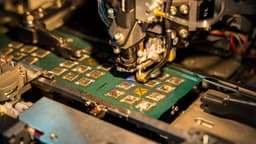
MicroCloud Hologram Explores Viable Full-Cycle Pathway for Quantum Computing
Collaborative QPU Utilization: MicroCloud Hologram suggests combining multiple Quantum Processing Units (QPUs) using circuit knitting technology to enhance computational capacity and tackle larger quantum computing tasks.
Error Control Techniques: The company emphasizes the importance of error suppression and mitigation methods to minimize the impact of errors on computational results with current hardware.
Algorithm Optimization: Focusing on heuristic quantum algorithms that provide asymptotic speedup can lead to efficient solutions for practical problems, even with existing quantum hardware limitations.
Short-term Computational Advantages: The proposed strategies aim to achieve computational advantages in the short term, leveraging collaborative QPU use, error control, and optimized algorithms.
Trade with 70% Backtested Accuracy
Analyst Views on HOLO
About HOLO
About the author


MicroCloud Hologram Unveils New Quantum Transmission Scheme

- Quantum Transmission Innovation: MicroCloud Hologram's new transmission scheme based on Brownian state quantum channels significantly enhances the efficiency of multi-particle entangled state transmission, providing a new pathway for the practical application of quantum communication technology, which is expected to drive industry growth.
- Application of Quantum Fourier Transform: The scheme employs quantum Fourier transform to construct a measurement framework that ensures accurate quantum state measurement, enhances system adaptability, simplifies operational processes, and improves implementation capabilities across different quantum hardware platforms.
- Breakthrough in Technical Architecture Design: By establishing stable quantum links, MicroCloud Hologram achieves quantum correlation between the transmission state and channel state when transmitting three-particle GHZ states, showcasing its core application potential in quantum network architectures.
- Broad Future Development Prospects: This transmission protocol demonstrates extensive application potential in specific scenarios such as quantum secure communication and distributed quantum measurement, and with advancements in quantum hardware technology, it is expected to play a crucial role in future quantum information systems.

MicroCloud Hologram (HOLO) Unveils Quantum Algorithm Hardware Acceleration Technology with 1.7x Performance Boost
- Technological Innovation: MicroCloud Hologram's proposed hardware acceleration technology converts quantum tensor network algorithms into parallel computing circuits that run on FPGAs, achieving efficient quantum spin model simulations and marking a new path for quantum physics research.
- Performance Breakthrough: This technology enables complex tensor network computational tasks to operate 1.7 times faster on FPGAs than on CPUs, with energy efficiency improved by over 2 times, significantly enhancing the efficiency of hardware implementations of quantum algorithms.
- Architectural Design: By constructing a Hierarchical Tensor Contraction Pipeline, MicroCloud Hologram achieves high-density parallel computing, optimizing memory access and control overhead, laying the groundwork for the hardware implementation of quantum computing core modules.
- Future Outlook: The company plans to advance the FPGA implementation of quantum variational algorithms, quantum linear system solvers, and other core modules, aiming to build a complete quantum algorithm acceleration ecosystem and promote the industrialization of quantum technology.
MicroCloud Hologram Inc. Unveils Quantum Algorithm Hardware Acceleration Technology with 1.7x Performance Boost
- Technological Innovation: MicroCloud Hologram's proposed hardware acceleration technology converts quantum tensor network algorithms into parallel computing circuits that run on FPGAs, achieving efficient quantum spin model simulations and marking a new path for quantum physics research.
- Performance Breakthrough: This technology enables complex tensor network computational tasks to run 1.7 times faster on FPGAs compared to CPUs, while also improving energy efficiency by over 2 times, significantly reducing memory access consumption and control overhead.
- Architectural Design: By constructing a Hierarchical Tensor Contraction Pipeline, MicroCloud has achieved a high-density parallel computing architecture that optimizes data flow scheduling and enhances the parallelism of computing units, ensuring maximum computational throughput under limited logic resources.
- Future Outlook: MicroCloud plans to further advance the hardware implementation of quantum computing core modules, including quantum variational algorithms and FPGA-ization of quantum machine learning models, aiming to build a complete quantum algorithm acceleration ecosystem and promote the industrialization of quantum technology.
MicroCloud Hologram Launches Scalable Multi-FPGA Quantum Simulator Technology
- Technological Breakthrough: MicroCloud Hologram has launched a scalable quantum Fourier transform simulator based on multi-FPGA and high-bandwidth memory, significantly enhancing quantum algorithm simulation capabilities and laying the groundwork for future larger-scale quantum computing.
- Storage Innovation: The new technology utilizes high-bandwidth memory to store complex amplitudes of quantum states, enabling read and update speeds that far exceed traditional DDR memory, thus meeting the high-speed data access demands of quantum computing.
- Multi-FPGA Scalability: This simulator employs an efficient domain decomposition strategy to distribute computation tasks across multiple FPGAs, minimizing cross-FPGA communication volume and thereby enhancing overall computational efficiency.
- Long-term Value: MicroCloud's multi-FPGA simulator will not only serve quantum algorithm researchers but also play a crucial role in quantum compiler optimization and quantum chip architecture verification, addressing a significant technical gap in the quantum computing ecosystem.
MicroCloud Hologram Launches Scalable Multi-FPGA Quantum Fourier Transform Simulator
- Technological Breakthrough: MicroCloud Hologram has launched a scalable quantum Fourier transform simulator based on multi-FPGA and high-bandwidth memory, significantly enhancing quantum algorithm simulation capabilities and laying the groundwork for future large-scale quantum computing.
- Storage Innovation: The new platform utilizes high-bandwidth memory to store complex amplitudes of quantum states, enabling read and update speeds that far exceed traditional DDR memory, thereby improving simulation efficiency and accuracy.
- Enhanced Scalability: By employing an efficient domain decomposition strategy, this technology supports distributed parallel simulation across FPGAs, optimizing the allocation of computational tasks for quantum circuits while reducing cross-chip communication demands.
- Market Prospects: MicroCloud Hologram's technology will provide crucial support for quantum algorithm research and quantum compiler optimization, and is expected to drive rapid development in the quantum computing ecosystem.
MicroCloud Hologram Unveils Quantum Spectral Filter Technology, Enhancing Graph Neural Network Performance
- Technological Innovation: MicroCloud Hologram's learnable quantum spectral filter technology maps the graph Laplacian operator to a trainable quantum circuit, achieving exponential compression capability for graph signal processing, marking a key step toward the practical application of quantum graph machine learning.
- Computational Efficiency Improvement: This technology enables processing of graphs with one million nodes using only about 20 qubits, significantly reducing computational costs compared to traditional graph neural networks, thus enhancing the feasibility of large-scale graph learning.
- Industry Application Prospects: As the number of nodes in fields like social media and traffic flow networks grows exponentially, quantum spectral filters provide a disruptive solution to complex structure learning challenges, indicating broad future applications for quantum-classical graph neural networks.
- Strategic Investment: MicroCloud plans to invest over $400 million from its cash reserves exceeding 3 billion RMB into blockchain and quantum computing, demonstrating its long-term strategic focus on advancements in quantum computing and holographic technology.
MicroCloud Hologram Unveils New Quantum Transmission Scheme
- Quantum Transmission Innovation: MicroCloud Hologram's new transmission scheme based on Brownian state quantum channels significantly enhances the efficiency of multi-particle entangled state transmission, providing a new pathway for the practical application of quantum communication technology, which is expected to drive industry growth.
- Application of Quantum Fourier Transform: The scheme employs quantum Fourier transform to construct a measurement framework that ensures accurate quantum state measurement, enhances system adaptability, simplifies operational processes, and improves implementation capabilities across different quantum hardware platforms.
- Breakthrough in Technical Architecture Design: By establishing stable quantum links, MicroCloud Hologram achieves quantum correlation between the transmission state and channel state when transmitting three-particle GHZ states, showcasing its core application potential in quantum network architectures.
- Broad Future Development Prospects: This transmission protocol demonstrates extensive application potential in specific scenarios such as quantum secure communication and distributed quantum measurement, and with advancements in quantum hardware technology, it is expected to play a crucial role in future quantum information systems.
MicroCloud Hologram (HOLO) Unveils Quantum Algorithm Hardware Acceleration Technology with 1.7x Performance Boost
- Technological Innovation: MicroCloud Hologram's proposed hardware acceleration technology converts quantum tensor network algorithms into parallel computing circuits that run on FPGAs, achieving efficient quantum spin model simulations and marking a new path for quantum physics research.
- Performance Breakthrough: This technology enables complex tensor network computational tasks to operate 1.7 times faster on FPGAs than on CPUs, with energy efficiency improved by over 2 times, significantly enhancing the efficiency of hardware implementations of quantum algorithms.
- Architectural Design: By constructing a Hierarchical Tensor Contraction Pipeline, MicroCloud Hologram achieves high-density parallel computing, optimizing memory access and control overhead, laying the groundwork for the hardware implementation of quantum computing core modules.
- Future Outlook: The company plans to advance the FPGA implementation of quantum variational algorithms, quantum linear system solvers, and other core modules, aiming to build a complete quantum algorithm acceleration ecosystem and promote the industrialization of quantum technology.
MicroCloud Hologram Inc. Unveils Quantum Algorithm Hardware Acceleration Technology with 1.7x Performance Boost
- Technological Innovation: MicroCloud Hologram's proposed hardware acceleration technology converts quantum tensor network algorithms into parallel computing circuits that run on FPGAs, achieving efficient quantum spin model simulations and marking a new path for quantum physics research.
- Performance Breakthrough: This technology enables complex tensor network computational tasks to run 1.7 times faster on FPGAs compared to CPUs, while also improving energy efficiency by over 2 times, significantly reducing memory access consumption and control overhead.
- Architectural Design: By constructing a Hierarchical Tensor Contraction Pipeline, MicroCloud has achieved a high-density parallel computing architecture that optimizes data flow scheduling and enhances the parallelism of computing units, ensuring maximum computational throughput under limited logic resources.
- Future Outlook: MicroCloud plans to further advance the hardware implementation of quantum computing core modules, including quantum variational algorithms and FPGA-ization of quantum machine learning models, aiming to build a complete quantum algorithm acceleration ecosystem and promote the industrialization of quantum technology.
MicroCloud Hologram Launches Scalable Multi-FPGA Quantum Simulator Technology
- Technological Breakthrough: MicroCloud Hologram has launched a scalable quantum Fourier transform simulator based on multi-FPGA and high-bandwidth memory, significantly enhancing quantum algorithm simulation capabilities and laying the groundwork for future larger-scale quantum computing.
- Storage Innovation: The new technology utilizes high-bandwidth memory to store complex amplitudes of quantum states, enabling read and update speeds that far exceed traditional DDR memory, thus meeting the high-speed data access demands of quantum computing.
- Multi-FPGA Scalability: This simulator employs an efficient domain decomposition strategy to distribute computation tasks across multiple FPGAs, minimizing cross-FPGA communication volume and thereby enhancing overall computational efficiency.
- Long-term Value: MicroCloud's multi-FPGA simulator will not only serve quantum algorithm researchers but also play a crucial role in quantum compiler optimization and quantum chip architecture verification, addressing a significant technical gap in the quantum computing ecosystem.
MicroCloud Hologram Launches Scalable Multi-FPGA Quantum Fourier Transform Simulator
- Technological Breakthrough: MicroCloud Hologram has launched a scalable quantum Fourier transform simulator based on multi-FPGA and high-bandwidth memory, significantly enhancing quantum algorithm simulation capabilities and laying the groundwork for future large-scale quantum computing.
- Storage Innovation: The new platform utilizes high-bandwidth memory to store complex amplitudes of quantum states, enabling read and update speeds that far exceed traditional DDR memory, thereby improving simulation efficiency and accuracy.
- Enhanced Scalability: By employing an efficient domain decomposition strategy, this technology supports distributed parallel simulation across FPGAs, optimizing the allocation of computational tasks for quantum circuits while reducing cross-chip communication demands.
- Market Prospects: MicroCloud Hologram's technology will provide crucial support for quantum algorithm research and quantum compiler optimization, and is expected to drive rapid development in the quantum computing ecosystem.
MicroCloud Hologram Unveils Quantum Spectral Filter Technology, Enhancing Graph Neural Network Performance
- Technological Innovation: MicroCloud Hologram's learnable quantum spectral filter technology maps the graph Laplacian operator to a trainable quantum circuit, achieving exponential compression capability for graph signal processing, marking a key step toward the practical application of quantum graph machine learning.
- Computational Efficiency Improvement: This technology enables processing of graphs with one million nodes using only about 20 qubits, significantly reducing computational costs compared to traditional graph neural networks, thus enhancing the feasibility of large-scale graph learning.
- Industry Application Prospects: As the number of nodes in fields like social media and traffic flow networks grows exponentially, quantum spectral filters provide a disruptive solution to complex structure learning challenges, indicating broad future applications for quantum-classical graph neural networks.
- Strategic Investment: MicroCloud plans to invest over $400 million from its cash reserves exceeding 3 billion RMB into blockchain and quantum computing, demonstrating its long-term strategic focus on advancements in quantum computing and holographic technology.