
Key Takeaway
Stellantis has announced that its approximately 38,000 UAW-represented employees will receive zero profit-sharing payments for 2025—a devastating development for workers who have come to depend on these annual bonuses as a significant portion of their compensation. This marks the first time since 2011 that Stellantis (and previously Fiat Chrysler) workers will not receive profit-sharing checks, highlighting the severity of the company's financial crisis. The elimination comes after Stellantis posted a staggering $26.3 billion net loss for 2025, driven primarily by massive writedowns related to its failed electric vehicle strategy.
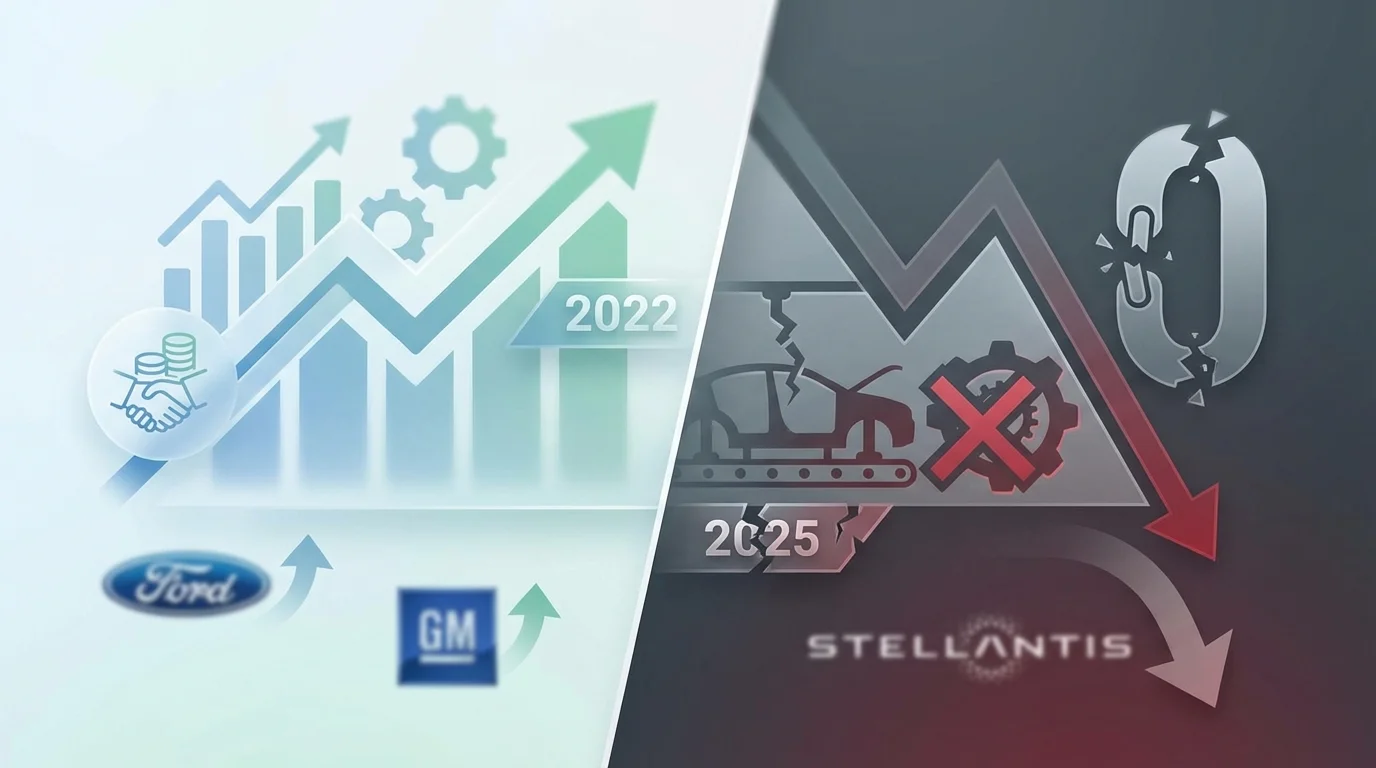
The contrast with Detroit's other automakers is stark and painful for Stellantis workers. While Stellantis employees receive nothing, Ford Motor Company UAW workers are set to receive $6,780 profit-sharing checks, and General Motors workers will receive even larger payments of $10,500. This disparity—more than $10,000 difference between GM and Stellantis workers—reflects fundamentally different financial trajectories among the Detroit Three and raises serious questions about Stellantis's competitive position and management decisions.
The root cause of the profit-sharing elimination lies in the specific terms of the 2023 UAW collective bargaining agreement. Under this contract, profit-sharing payments are tied to North American financial performance meeting minimum profitability thresholds. According to spokesperson Jodi Tinson, "As the North America results did not meet the minimum thresholds defined in the 2023 UAW collective bargaining agreement, there will be no profit sharing paid to UAW-represented employees for 2025." Even after excluding special charges related to EV strategy changes, North American profit margin remained negative, down $2.2 billion with a 3% decline.
The elimination of profit sharing represents more than just a financial setback for workers—it signals potential trouble for Stellantis's labor relations and workforce morale. These payments have historically served as a critical tool for aligning worker interests with company performance and maintaining competitive compensation in the automotive industry. With no profit sharing in 2026 and uncertainty about future payments, Stellantis may face challenges retaining skilled workers who can easily transfer to Ford or GM for substantially higher total compensation.
The $26.3 Billion Loss: Understanding Stellantis's Financial Crisis
Historic Loss and EV Strategy Failure
Stellantis's $26.3 billion net loss for 2025 represents one of the largest annual losses in automotive industry history and marks the company's first annual loss since its formation through the merger of Fiat Chrysler and PSA Group. To put this figure in perspective, the loss exceeds the market capitalization of many major corporations and wipes out years of accumulated profits. The previous year, Stellantis earned €5.5 billion ($5.9 billion), making the swing to a massive loss particularly dramatic.
The primary driver of this catastrophic loss was Stellantis's aggressive but ultimately flawed electric vehicle strategy. The company took massive writedowns as it reversed course on EV production plans, scaled back battery factory investments, and wrote down the value of EV-related assets. CEO Carlos Tavares's push for rapid electrification collided with market reality—slower-than-expected EV adoption, higher production costs, and intense competition from Tesla and Chinese manufacturers.
The second half of 2025 was particularly devastating, with Stellantis reporting a net loss of $23.8 billion in just six months. This acceleration of losses in the latter part of the year suggests that management's strategy adjustments came too late to prevent significant financial damage. The company has since pivoted back to emphasizing internal combustion engines, hybrid vehicles, and its iconic Jeep and Ram brands, but the financial carnage from the EV misadventure will take years to repair.
North America Performance Collapse
While Stellantis's global operations struggled, the North American business—historically its most profitable region—delivered particularly disappointing results. North American profit margin turned negative in 2025, declining $2.2 billion with a 3% drop. This collapse in the company's most important market directly triggered the profit-sharing elimination, as the 2023 UAW agreement ties payments to North American profitability thresholds.
Several factors contributed to the North American decline. Inventory mismanagement led to excessive stockpiles of vehicles that required heavy discounting to move. The company's aggressive pricing strategy early in the year alienated customers and damaged brand value. Production disruptions and quality issues with new models further hurt sales. Meanwhile, competitors like GM and Ford executed more effectively, capturing market share from the struggling Stellantis brands.
The North American results are especially concerning because this region has traditionally generated the profits that subsidized Stellantis's operations in less profitable European and other global markets. With North America now losing money, the company's entire financial model is under stress. Restoring profitability in this critical market will be essential for any future profit-sharing payments and for the company's long-term viability.
The Profit-Sharing Disparity: Stellantis vs. Ford vs. GM
0 vs.6,780 vs. $10,500
The contrast in profit-sharing outcomes among the Detroit Three automakers in 2026 tells a clear story about which companies successfully navigated 2025's challenges and which stumbled. Stellantis workers receive nothing, while Ford UAW members will get $6,780 checks and GM workers will receive $10,500. This more than $10,000 gap between GM and Stellantis represents a substantial difference in annual compensation for workers performing similar jobs at competing companies.
Ford's $6,780 profit-sharing payment comes despite the company also posting a full-year loss in 2025. However, Ford's North American operations remained profitable enough to trigger the profit-sharing formula in the UAW contract. This highlights a critical difference—while both Ford and Stellantis lost money globally, Ford managed to keep its core North American business in the black, whereas Stellantis did not.
General Motors emerged as the clear winner among Detroit automakers, delivering strong enough performance to generate $10,500 profit-sharing payments. GM's more balanced approach to electrification, better inventory management, and stronger truck and SUV sales allowed it to maintain profitability even in a challenging environment. GM workers will receive the highest profit-sharing payments among the three companies, reinforcing GM's position as the most financially stable of the traditional Detroit automakers.
Historical Context: From $14,760 to $0
The elimination of 2025 profit sharing stands in stark contrast to recent years when Stellantis workers received substantial bonuses. In 2022, eligible UAW-represented employees received $14,760 profit-sharing payments—among the highest in the industry. This payment reflected strong financial performance and represented a significant portion of worker compensation. The swing from nearly $15,000 to zero in just three years illustrates the dramatic reversal in Stellantis's fortunes.
The 2022 payment was based on 2021 financial results, which were exceptionally strong as the automotive industry recovered from pandemic disruptions and Stellantis benefited from high vehicle prices and strong demand. At that time, Stellantis appeared to be successfully executing its merger integration and building momentum. Few could have predicted that just four years later, the company would be posting massive losses and eliminating profit sharing entirely.
Looking back further, Stellantis and its predecessor Fiat Chrysler have generally provided profit-sharing payments to UAW workers since 2011. The elimination of 2025 payments breaks this 14-year streak and returns workers to the era of the financial crisis when automakers were hemorrhaging cash and dependent on government bailouts. For workers who have come to view profit sharing as a reliable component of their compensation, the $0 payment represents a significant financial and psychological blow.
The 2023 UAW Agreement and Profit-Sharing Thresholds
How Profit Sharing Works
The profit-sharing formula under the 2023 UAW collective bargaining agreement ties worker bonuses directly to North American financial performance. Unlike some companies that pay bonuses based on subjective management discretion, the UAW contract specifies objective thresholds that must be met before any payments are triggered. This structure aligns worker interests with company profitability but also means that workers bear the risk when performance deteriorates.
The specific thresholds in the 2023 agreement require North American operations to achieve minimum profitability levels before profit sharing is activated. While the exact formula is complex, the fundamental principle is straightforward: if North America loses money, workers get nothing. Stellantis's North American profit margin turned negative in 2025, falling $2.2 billion into the red, which automatically eliminated profit-sharing eligibility regardless of the company's global results or special charges.
The agreement also caps maximum profit-sharing payments, with workers eligible to receive up to a certain percentage of their annual compensation based on company performance. In strong years, these caps can limit payments even when the company generates massive profits. However, in 2025, the issue was not caps but rather the complete absence of profitability needed to trigger any payment whatsoever.
Special Charges and Accounting Treatment
Stellantis attempted to draw a distinction between its reported net loss and underlying operational performance by highlighting that the $26.3 billion figure includes special charges related to EV strategy changes. Management emphasized that excluding these charges would show different results. However, for profit-sharing purposes, the relevant metric is North American profitability, which remained negative even after accounting adjustments.
The company reported that even with special charges excluded, North American profit margin remained negative with a $2.2 billion decline. This technical accounting point is cold comfort for workers hoping that non-recurring charges might preserve their profit-sharing eligibility. The UAW agreement's profit-sharing formula is based on reported North American results, and those results were unequivocally negative.
The accounting treatment of EV-related writedowns will continue to affect Stellantis's financial statements for years to come as the company works through the stranded assets and contract obligations from its abandoned electrification strategy. While future years may show improved underlying performance, the legacy of 2025's massive losses will hang over the company and its workers for some time.
Impact on Workers and Labor Relations
Financial Impact on UAW Families
The elimination of profit sharing represents a significant financial blow for Stellantis's approximately 38,000 UAW-represented employees and their families. For many workers, profit-sharing payments have become an essential component of annual income used for major expenses, debt reduction, savings, and discretionary spending. The loss of thousands of dollars in expected income will force many families to adjust their budgets and delay planned purchases.
The contrast with Ford and GM workers receiving substantial payments adds a psychological dimension to the financial hardship. Stellantis workers see their neighbors and colleagues at competing plants receiving $6,780 or $10,500 checks while they get nothing. This disparity creates natural resentment and raises questions about whether Stellantis's management decisions—particularly around the failed EV strategy—were wise or whether different choices could have preserved profitability and profit-sharing eligibility.
The financial impact extends beyond individual families to the broader communities where Stellantis operates. Profit-sharing payments historically provided an economic stimulus to areas around assembly plants and manufacturing facilities. Local businesses—car dealerships, retailers, restaurants—benefited from workers spending their bonus checks. The elimination of these payments in 2026 will be felt throughout Stellantis communities, compounding the direct impact on workers.
Labor Relations and Contract Negotiations
The profit-sharing elimination comes at a sensitive time for Stellantis's labor relations. The company is still implementing the 2023 UAW agreement and dealing with ongoing tensions from the 2023 strike that shut down plants for weeks. The absence of profit-sharing payments removes a tool that historically helped maintain positive worker relations during difficult periods.
Looking ahead to the next round of contract negotiations in 2027, the 2025 profit-sharing elimination will likely be a major point of contention. UAW leadership can point to the $0 payment as evidence that Stellantis's management has failed workers and demand stronger protections, higher base wages, or modifications to the profit-sharing formula. The union may seek to lower the thresholds for profit-sharing eligibility or increase minimum guarantees to prevent future $0 payments.
Stellantis management faces a delicate balancing act. The company needs worker cooperation to implement its turnaround strategy, yet it has limited financial resources to offer immediate concessions. Workers who feel mistreated or undercompensated may resist productivity improvements or quality initiatives, further complicating the recovery effort. Restoring profitability will be essential not just for financial health but also for rebuilding the worker trust necessary for long-term success.
The Road Ahead: Can Stellantis Restore Profitability?
Management's Turnaround Strategy
In response to the disastrous 2025 results, Stellantis CEO Carlos Tavares and his team have announced a significant strategic pivot. The company is scaling back its ambitious EV targets, delaying battery factory investments, and refocusing on profitable internal combustion engine vehicles, particularly the iconic Jeep and Ram brands. This represents a humbling admission that the previous strategy was flawed and that Stellantis cannot afford to continue hemorrhaging cash on electrification efforts.
The turnaround plan emphasizes near-term profitability over long-term transformation. Management has identified specific cost reduction targets, inventory reduction goals, and pricing strategy adjustments designed to restore North American profitability in 2026. The plan includes workforce reductions, production cuts at underperforming plants, and a renewed focus on the truck and SUV segments where Stellantis has historically been strongest.
Investor reaction to the turnaround plan has been cautious but somewhat optimistic. While the $26.3 billion loss was shocking, the strategic pivot and specific action items provide a roadmap for recovery. The key question is whether management can execute this turnaround quickly enough to prevent further market share erosion and worker attrition. The automotive industry moves slowly, and recovering from a year as bad as 2025 will take time.
Outlook for Future Profit Sharing
Whether Stellantis workers will receive profit-sharing payments in 2027 and beyond depends entirely on the company's ability to restore North American profitability. If management's turnaround strategy succeeds and North American operations return to profitability in 2026, workers could once again receive payments under the 2023 UAW agreement. However, if losses continue or the turnaround falters, workers may face multiple years without profit sharing.
The UAW contract runs through 2027, meaning the current profit-sharing formula will remain in place for at least two more years. Workers have the security of knowing that if the company performs well, they will be compensated accordingly. However, they also bear the risk that continued poor performance will mean continued $0 payments. The union may seek to modify this formula in the next negotiation to provide some minimum payment or lower the profitability thresholds.
For now, Stellantis workers must navigate 2026 without the profit-sharing payments they have come to expect. This will require financial adjustments and patience as management attempts to turn around the company. The contrast with Ford and GM workers receiving substantial payments will make this period particularly challenging for Stellantis employees and their families.
Investment Implications and Stock Performance
Stellantis Stock Reaction
Stellantis shares (ticker: STLA) have faced significant pressure following the announcement of the $26.3 billion loss and profit-sharing elimination. The stock has declined substantially from its highs as investors grapple with the severity of the company's financial crisis and the uncertainty surrounding its turnaround prospects. The elimination of profit sharing, while not directly impacting financial results, signals to investors that the company's operational challenges are serious and that management faces a difficult road ahead.
The profit-sharing elimination may also concern investors watching Stellantis's labor relations. Companies with poor worker relations often face productivity challenges, quality issues, and higher turnover—all of which can impact long-term financial performance. If the $0 payment creates lasting resentment among workers, Stellantis may struggle to execute its turnaround effectively even if the strategic direction is sound.
Comparatively, Ford and GM shares have performed better as investors reward their stronger financial results and more stable labor relations. The profit-sharing disparity reflects broader differences in execution and financial management among the Detroit Three. Investors seeking exposure to the U.S. automotive recovery may prefer Ford or GM given their current profitability and more reliable dividend and profit-sharing track records.
Analyst Perspectives
Wall Street analysts have generally downgraded Stellantis following the 2025 results, with many expressing skepticism about the company's near-term prospects. The $26.3 billion loss was far worse than most analysts had modeled, and the EV strategy reversal raises questions about management's judgment and the company's competitive position. Some analysts have cut price targets or recommended selling shares until the turnaround shows clearer signs of progress.
However, contrarian investors might see opportunity in Stellantis's beaten-down shares. The company still owns valuable brands including Jeep, Ram, Dodge, and Chrysler, and its global manufacturing footprint provides strategic optionality. If management successfully executes the turnaround and restores profitability, the stock could deliver substantial returns from current depressed levels. This is a high-risk, high-reward proposition that requires confidence in the current management team's ability to learn from its mistakes.
The next few quarters will be critical for Stellantis's stock performance. Investors will watch closely for signs of North American profitability improvement, inventory normalization, and successful product launches. If the company can demonstrate progress on these metrics, sentiment could improve quickly. If challenges persist, the stock could face further downside as investors lose patience with the turnaround story.
Ready to stay informed on automotive industry developments? Intellectia's AI-powered market intelligence platform provides real-time insights on labor relations, earnings reports, and investment opportunities across the automotive sector. Our platform aggregates thousands of data sources to help you navigate complex industry dynamics.

Conclusion
Stellantis's elimination of 2025 profit-sharing payments for its 38,000 UAW workers marks a historic low point for the company and a painful setback for employees who have come to depend on these annual bonuses. The $26.3 billion net loss—the largest in company history and the first annual loss since the Fiat Chrysler-PSA merger—reflects management's failed electric vehicle strategy and operational challenges that have undermined the company's financial performance.
The contrast with Ford ($6,780) and GM ($10,500) profit-sharing payments highlights the disparity in execution among Detroit automakers. While all three companies faced similar industry headwinds in 2025, Ford and GM managed to maintain North American profitability sufficient to trigger profit-sharing payments, while Stellantis did not. This more than $10,000 compensation gap will create competitive pressure as Stellantis tries to retain skilled workers who can easily transfer to higher-paying competitors.
For Stellantis workers, the immediate future looks challenging. The 2023 UAW agreement ties profit sharing to North American profitability, and with North American operations losing money, no payments are forthcoming. Workers must navigate 2026 without the bonus income they have come to expect, forcing financial adjustments while hoping that management's turnaround strategy succeeds. The psychological impact of seeing colleagues at Ford and GM receive substantial payments while Stellantis workers get nothing should not be underestimated.
The longer-term question is whether Stellantis can restore profitability and return to paying profit sharing in future years. CEO Carlos Tavares's strategic pivot away from aggressive electrification and back toward profitable internal combustion vehicles represents a necessary course correction, but execution will be critical. The automotive industry is brutally competitive, and Stellantis has lost ground to rivals that made better strategic decisions.
For investors, Stellantis represents a high-risk turnaround story. The stock has been beaten down by the 2025 results, creating potential upside if management successfully executes the recovery plan. However, the company's challenges are significant, and the profit-sharing elimination signals that operational and labor issues may persist. Investors considering Stellantis shares should carefully weigh the potential returns against the substantial execution risks.
The 2025 profit-sharing elimination will be remembered as a watershed moment for Stellantis—a year when the company's strategic missteps caught up with it and workers paid the price. Whether this proves to be a temporary setback or the beginning of a longer decline depends on management's ability to learn from its mistakes and execute a successful turnaround in the years ahead.
Take your investment research to the next level with Intellectia's AI stock picker. Our advanced algorithms analyze thousands of data points to identify high-conviction opportunities, track analyst sentiment shifts, and provide actionable insights for stocks like Stellantis. Whether you're evaluating turnaround plays or exploring other investment themes, Intellectia provides the analytical edge you need to invest with confidence.